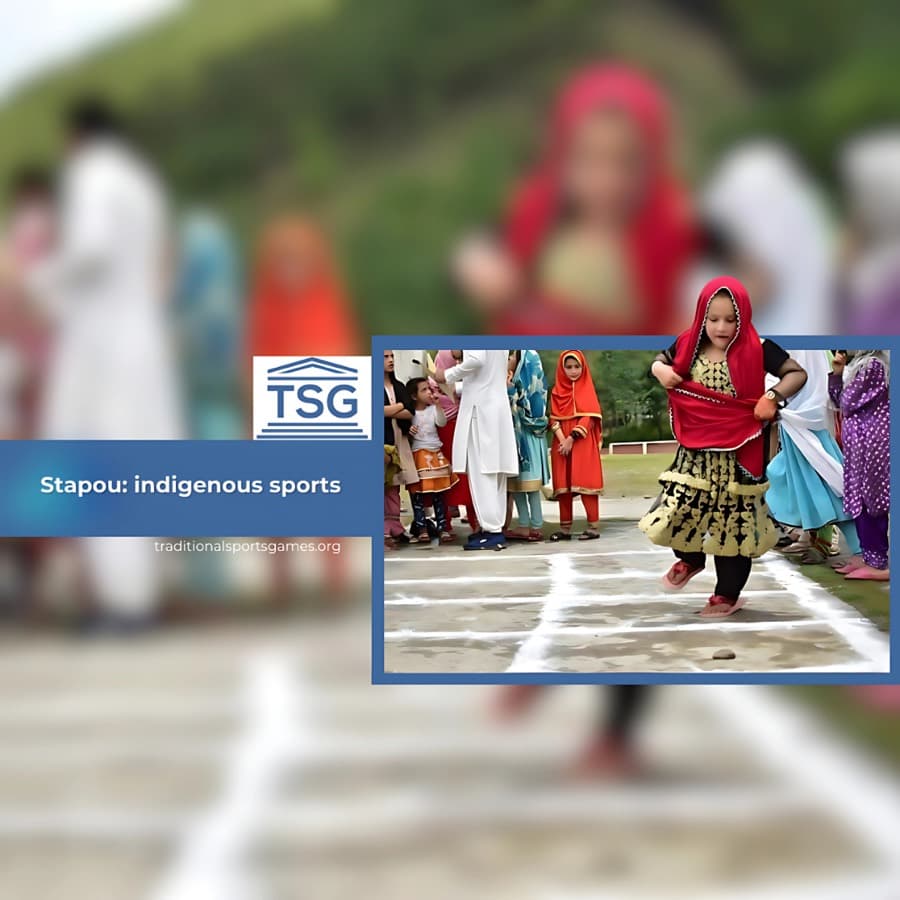
Stapoo: The Enduring Charm of Hopscotch in Pakistan’s Cultural Landscape In the dusty courtyards, schoolyards, and village lanes of Pakistan, there exists a timeless game that has transcended generations, borders, and trends—Stapoo, more widely known as Hopscotch. Though simple in form, it carries with it a profound legacy of play, learning, and social interaction. This cherished traditional game, played by both girls and boys, is a vivid reminder of how the spirit of play binds communities and nurtures childhood. At a time when digital distractions dominate leisure time, Stapoo remains a symbol of innocence, ingenuity, and cultural continuity. A Game Drawn from the Earth Stapoo is typically played outdoors, requiring only a small court drawn on the ground and a flat stone or marker—locally known as a "patti" or "tikka". The court is a sequence of numbered boxes, usually 6 to 10 squares, drawn with chalk, coal, or a stick in the dirt. Each square represents a level of progress and challenge. Players take turns throwing the stone into the numbered squares in order without letting it bounce out or land on a line. They must then hop through the squares, skip the one with the stone, and return, balancing on one foot throughout. The skill lies in accuracy, balance, and memory, as the game progresses to more difficult stages. More Than a GameStapoo is more than a childhood pastime—it is a cultural ritual. It teaches: Balance and coordination through physical movement. Turn-taking and fair play, which build social interaction. Memory and focus, as players remember sequences and steps. In villages, Stapoo is often accompanied by folk rhymes, laughter, and cheer, making it not just a solitary activity, but a communal celebration of youth. In urban neighborhoods, it thrives in schoolyards and alleys where tradition quietly resists the pull of modern distractions. A Living Legacy in Decline While Stapoo continues to be played in some rural and semi-urban areas of Pakistan, its prevalence is slowly fading due to urbanization, limited play spaces, and the rise of digital entertainment. Without concerted efforts to promote and preserve such games, there is a risk that future generations may never experience the simple joys of Stapoo. This is where the mission of the International Council of Traditional Sports and Games (ICTSG) becomes crucial. Stapoo, as an intangible cultural heritage, deserves formal recognition and revival. The ICTSG encourages educational institutions, community centers, and cultural organizations to integrate such traditional games into school curriculums, festivals, and awareness campaigns. Aligned with UNESCO’s framework, Stapoo embodies the principles of gender equality, inclusivity, and sustainable cultural preservation. Its promotion can also contribute toward the United Nations Sustainable Development Goals (SDGs)—particularly those related to quality education, health, and cultural diversity. Keeping Stapoo Alive: A Call to ActionLet us bring Stapoo back into our playgrounds and public spaces. Let our children learn the joy of hopping barefoot on warm earth, the thrill of a well-aimed toss, and the value of shared traditions. Let us ensure that this symbol of our collective heritage does not fade into silence, but instead continues to echo in the joyful shouts of future generations. Support the revival of Stapoo. Share it. Play it. Teach it. Celebrate it as a proud legacy of Pakistan’s traditional games.
When a sport disappears, it is like a language no longer spoken - its stories, values, and lessons risk being lost forever. When we revive a game, we revive a culture.
Khalil Ahmed Khan - President, ICTSG