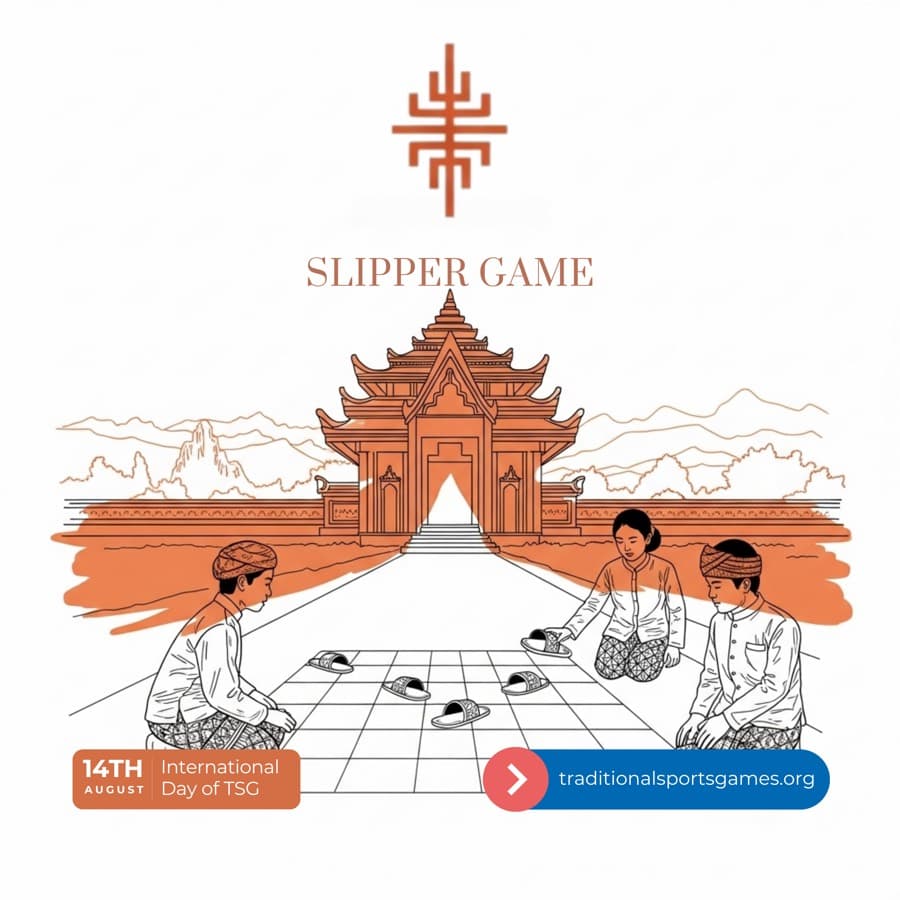
Slipper Game: Revitalizing Filipino Traditional Throwing Games for Cultural Heritage and Community Empowerment The Slipper Game is one of the most cherished traditional sports and games (TSG) in the Philippines. Known for its simplicity, excitement, and cultural value, the game uses slippers as a playful tool for throwing accuracy. This game supports the preservation of indigenous knowledge and the safeguarding of intangible heritage while promoting inclusive education, community participation, and youth empowerment. Historical Background The Slipper Game, often played by Filipino children in villages and urban communities, dates back generations. Requiring no expensive equipment, just slippers and open space, it became a universal symbol of childhood, resourcefulness, and social interaction, making it a staple in social practices and performing arts during town fiestas and school events. Gameplay Rules and Mechanics
A set of slippers is arranged in a stacked pile or target form at the center of a drawn circle. Players form teams and take turns throwing their slippers to knock over the pile from a designated distance. Once knocked down, the player who succeeded runs to retrieve their slipper and return to the start line before being tagged by defenders. Scoring is based on successful throws, retrievals, and defense tactics.
Cultural Significance Beyond a recreational activity, the Slipper Game carries deep cultural meaning. It reflects cultural diversity, resilience, and intergenerational transmission of play. The game fosters civil society engagement by creating informal learning environments where children, families, and communities share time and stories together. Strategic and Educational Value
Teaches agility, coordination, and reflexes in young players. Promotes fairness, teamwork, and rule-based interaction. Encourages critical thinking and quick decision-making. Supports emotional development through cooperation and conflict resolution. Acts as a tool for inclusive education and experiential learning.
Community Impact and Sustainability The Slipper Game utilizes everyday objects and requires no manufactured tools, making it a model of sustainable development. Its wide accessibility ensures it thrives in both urban and rural areas, uniting communities and promoting local heritage without environmental strain. Similar Traditional Games from Around the World
Boina (South America – Object Toss) Lippa (Italy – Bat and Toss Game) Kalahoyo (Philippines – Pebble Game)
These games reflect a universal tradition of playful learning and physical engagement across continents. Alignment with UNESCO’s Sustainable Development Goals (SDGs)
SDG 4: Strengthens quality education through hands-on heritage learning. SDG 5: Promotes gender equity by allowing all children to participate equally. SDG 10: Reduces inequality by valuing local and indigenous knowledge systems. SDG 11: Builds sustainable communities through cultural preservation. SDG 16: Encourages peace, fairness, and inclusive recreational spaces. SDG 17: Connects global networks for safeguarding traditional games and cooperation.
Call to Action Join us in reviving traditional games like the Slipper Game to foster inclusion, learning, and global heritage preservation. Empower youth, support cultural identity, and make play a tool for sustainable development. Get Involved Benefits of Joining Support ICTSG
About ICTSG: ICTSG champions the safeguarding of traditional sports and games globally. Through collaboration and advocacy, we promote cultural diversity, educational innovation, and sustainable community development. About Us | History | Contact
When a sport disappears, it is like a language no longer spoken - its stories, values, and lessons risk being lost forever. When we revive a game, we revive a culture.
Khalil Ahmed Khan - President, ICTSG