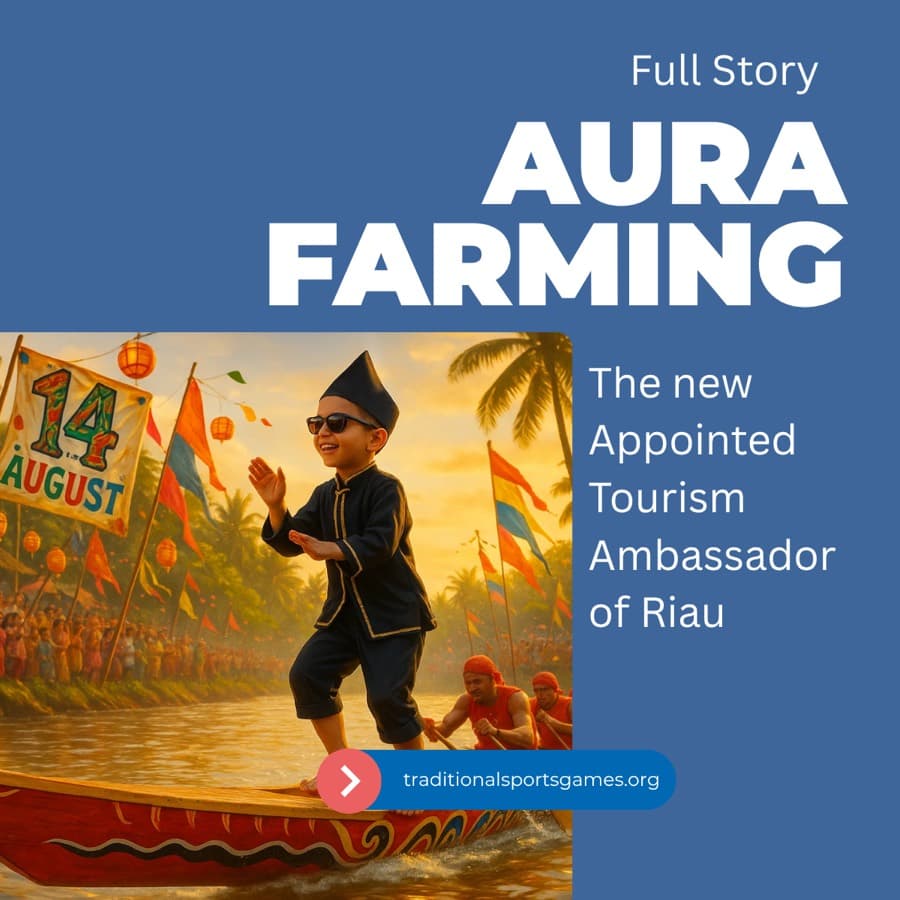
The Vibe of 2025: Rayyan, Pacu Jalur & the Rise of Traditional Sports on the Global Stage In a digital world where trends come and go in seconds, one 11-year-old boy from Indonesia has carved a place in history—not with a gadget, but on the tip of a traditional boat. Rayyan Arkan Dikha, a young boy from Riau Province, became an overnight sensation in 2025 when his spirited dance atop a Pacu Jalur boat went viral, breathing life and global attention into a centuries-old tradition. His videos, flooding timelines across TikTok, Instagram, and YouTube, have not only popularized the term "aura farming"—a euphemism for radiating charisma and cultural pride—but have positioned Traditional Sports and Games (TSG) as the year's most celebrated grassroots movement. What Is Pacu Jalur? Pacu Jalur is not just a race. It is a riverine festival, a cultural theatre, and a time capsule of heritage in motion. Originating in the Kuansing Regency of Riau, Indonesia, Pacu Jalur is a longboat rowing competition with boats often stretching up to 40 meters in length, manned by 40–60 rowers. Dating back to the 17th century, this sport was historically a royal event, used by Malay kings as a celebration of unity, harvest, or to honor guests. Every August, villages in Riau converge on the Batang Kuantan River to participate in the grandest iteration of this festival. The rowers, dressed in traditional uniforms, paddle to the beating rhythm of traditional drums and chants, while thousands line the riverbanks to witness the spectacle. The front of the boat often features a dancer or flag bearer—a ceremonial position that Rayyan now embodies with youthful vibrance. Rayyan Arkan Dikha: A Child of the Culture, Star of the Screen What started as a moment of joy—a local boy swaying with spirit and confidence on the bow of a Pacu Jalur—became a viral moment seen by millions. His flawless timing, infectious smile, and the cultural rhythm of his moves captivated the internet. What’s more important is why this resonated: Rayyan was not mimicking trends; he was reviving one. Declared a Tourism Ambassador of Riau at just 11 years old, Rayyan’s rise is symbolic. He is a living bridge between ancient practices and digital relevance. His videos are now used by teachers to educate students on TSG. His persona is shared by ministries to attract tourists. And more importantly, his charm has awakened young people across the world to the power of traditional play. 2025: The Year Traditional Sports Became a Vibe Across continents, 2025 has witnessed a remarkable revival of indigenous sports—not just as folklore, but as living, breathing, and trending activities. From Buzkashi in Central Asia to Capoeira circles in Brazil, Inuit games in Canada, and Kabaddi in South Asia, the digital sphere has become a new arena for these sports to shine. The International Council of Traditional Sports and Games (ICTSG), the world’s leading platform for the promotion and safeguarding of TSG, has declared 14 August as the International Day of Traditional Sports and Games—a date now marked by festivals, tournaments, and celebrations around the globe. And in this year’s observance, Rayyan is being recognized as the “Digital Face of TSG Revival.” The Social Media Factor: From Playground to Platform Why now? Why Rayyan? The answer lies in the intersection of authenticity, culture, and technology. Traditional sports used to be passed down through oral storytelling or community demonstration. Today, reels, short-form videos, and livestreams have become the new medium of preservation. A child dancing on a boat in rural Indonesia now garners more views than professional athletes. Why? Because it is raw, real, and rooted. TikTok, in particular, has proven to be a game changer for traditional games. Young creators from Mongolia, Africa, the Pacific Islands, and Latin America are using short videos to showcase sports that were once at risk of extinction. Hashtags like #MyTraditionalGame, #PlayThePast, and #TSGVibe2025 have trended multiple times this year. Even more interestingly, youth engagement is no longer limited to spectatorship. Virtual challenges like “Dance Your Heritage,” “Row with Rayyan,” and “Local Sport, Global Stage” have encouraged kids around the world to try their own traditional sports, film it, and post it with pride. Sports as Diplomacy, Culture as Peace The ICTSG and cultural organizations globally have recognized this wave not just as a social media trend but as a catalyst for international understanding. Sports have always had a diplomatic role, but traditional sports go a step deeper—they embody community, respect, and diversity. Rayyan’s story isn’t just about viral fame—it’s about how a community tradition, performed with love and authenticity, can transcend borders and inspire global curiosity. His presence on the boat has now inspired young people in Senegal to re-embrace wrestling festivals, children in Iran to revive Pahlevani, and youth in Peru to film ancient Incan running rituals. In doing so, he has personified the ICTSG mission: that traditional sports are not relics, but relevant—not just heritage, but hope. Indonesia’s Role as a Member of TSG Community. Indonesia has long been a champion of cultural preservation. The Traditional and Indegineous Sports of Indonesia are quite popular in Asia. Rayyan’s rise is therefore not an anomaly—it is a natural continuation of the country’s leadership in cultural diplomacy. Conclusion: The Legacy of Rayyan and the Rise of the New Rayyan Arkan Dikha may have been dancing on a boat, but he stirred a global current. In a time where cultural traditions often struggle to compete with modern entertainment, one boy reminded us that the oldest rhythms can still make the loudest noise—especially when shared with authenticity. The story of Pacu Jalur in 2025 is not just the story of a festival, or a child, or even a sport—it is the story of how Traditional Sports and Games have re-entered the global consciousness, not as folklore, but as a future-forward movement for unity, identity, and peace. In a world divided by politics, algorithms, and noise, maybe what we all needed was the beat of a drum, the pulse of a paddle, and a boy with joy in his steps.
When a sport disappears, it is like a language no longer spoken - its stories, values, and lessons risk being lost forever. When we revive a game, we revive a culture.
Khalil Ahmed Khan - President, ICTSG