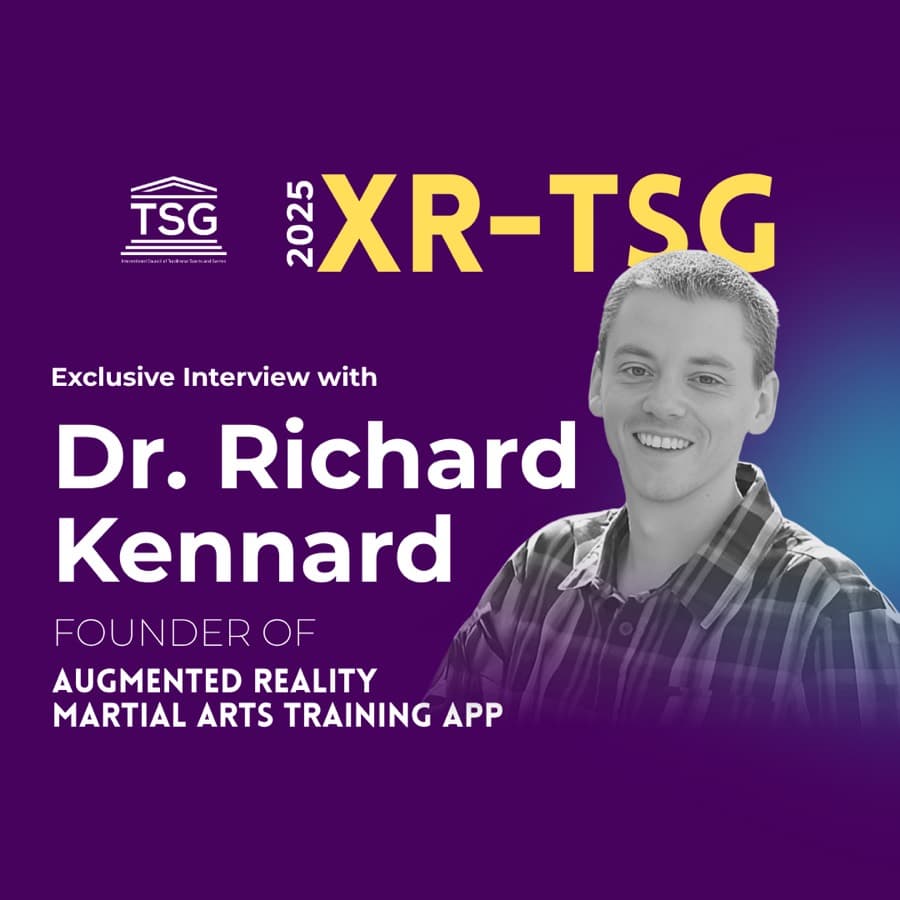
Interview with Dr. Richard Kennard: XR, Martial Arts, and the Future of Traditional Games Published in honor of the International Day of Traditional Sports and Games – 14 August 2025 As part of the global celebration of Traditional Sports and Games (TSG), we sat down with Dr. Richard Kennard, creator of PozeAR — a pioneering Augmented Reality (AR) platform designed to train martial arts through immersive learning. A Developer’s Journey Begins in the Dojang “I’m a software developer — and a father. When my son started Taekwondo at age 7, I joined in to support him. Five years later, we were both preparing for our black belt exams,” Dr. Kennard shares. “I struggled a lot. I couldn’t understand exactly what my instructors wanted from me. That got me thinking: what would help someone like me actually learn better?” That question led to a prototype. Inspired by sci-fi concepts like holograms, Dr. Kennard imagined a tool that could visually guide movement in 3D space. The result? PozeAR, a low-cost, easy-setup AR application designed to teach martial arts — not through observation, but by doing. Muscle Memory, Freeze Walking, and Game Mechanics “Muscle memory is the real key. You learn best by constantly doing — not watching and then trying,” he explains. One innovation in PozeAR was inspired by the TikTok trend ‘Freeze Walking’. “I created outlines — yellow for target, green for goal — that people could walk into, allowing the app to correct form and confirm stance before moving forward.” He layered in gamification features: difficulty levels, scoring systems, performance tracking. “This isn’t just tech — it’s motivation.” Proprioception and the Power of Seeing Yourself “People don’t realize how little of their body they can actually see at any time. Our brain fills in the blanks using proprioception — the sense of where your limbs are. But AR only feeds your eyes. That’s a limitation.” So he built solutions: overlays that teach spatial awareness, mirror modes to self-correct form, and even a replay system where users can interact with their past self. “One day I answered my phone during a test. In playback, I saw myself do it. It was uncanny — but useful.” Miniature Mode, Mirror Mode, and SprintAR “One time I set the instructor’s scale wrong, and he appeared tiny. But it turned out to be really helpful — like a diorama. It gave users a better overview of the full routine.” He integrated this as Miniature Mode. Alongside that came Mirror Mode for body correction and SprintAR, a feature where users could watch and race their previous actions. Lessons for the TSG Community Dr. Kennard isn’t claiming to convert TSG into XR. “But I believe the Traditional Sports and Games community can benefit from how we’ve solved problems in modern sport training. TSG often involves culturally rooted, geographically specific, and language-driven knowledge. That makes the challenge — and opportunity — even greater.”
Body Tracking: Still limited, especially for lower limbs Physical Resistance: Missing in XR; a safety and realism issue Non-linear presentation: A powerful model for heritage sports Authenticity over Graphics: Design must reflect culture, not just polish
“What you need isn’t perfect hardware,” he concludes. “What you need is clarity, creativity, and the courage to start building with what’s already in your hands.” 📽️ Watch Dr. Richard’s Talk The full presentation by Dr. Kennard will be released on our YouTube channel as part of the 14 August celebration.
📩 Submit your reflections or questions to communications@traditionalsportsgames.org The TSG Community extends its gratitude to Dr. Richard Kennard for sharing his story and inspiring us to explore the future of immersive sports learning.
When a sport disappears, it is like a language no longer spoken - its stories, values, and lessons risk being lost forever. When we revive a game, we revive a culture.
Khalil Ahmed Khan - President, ICTSG