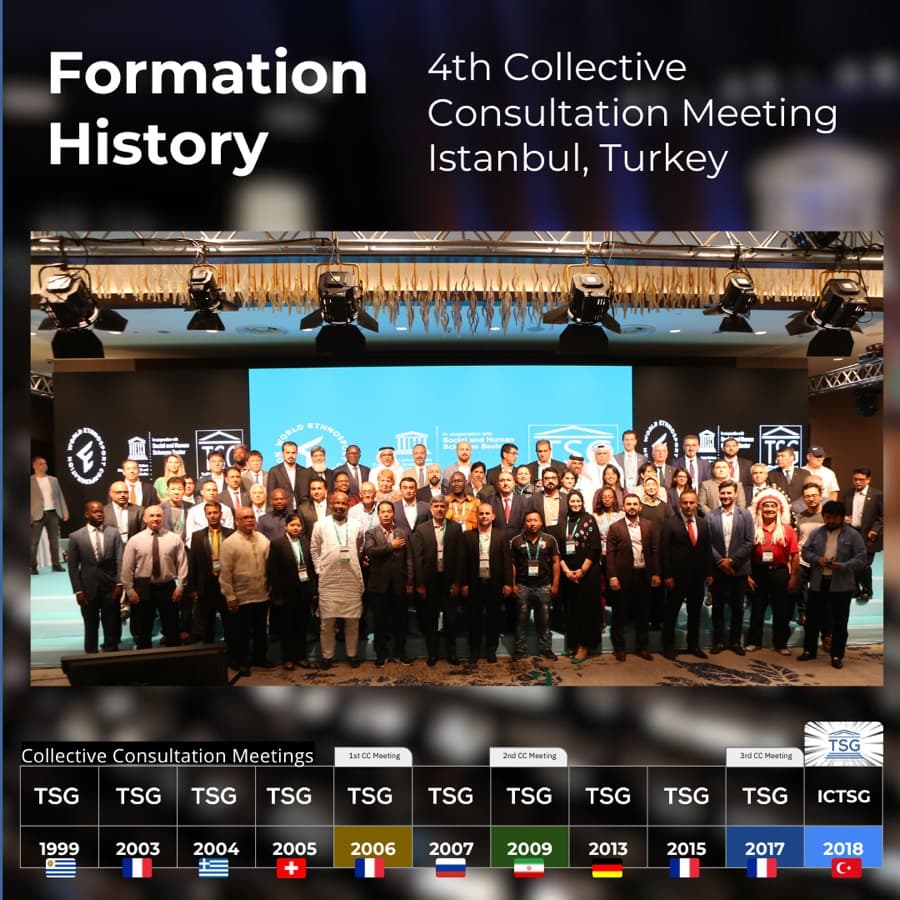
History Formation and Legal background of ICTSG Traditional sports and games contribute to a life of mutual understanding and peaceful behavior among different cultural and social groups, communities, and nations. They are a means of their identity. Therefore, the significance of traditional sports and games must be strengthened and the opportunity for practicing them must be held open for all human beings especially for young people, the physically challenged, and disadvantaged groups in society. Safeguarding and promoting Traditional Sport and Games (TSG) requires developing knowledge, sharing information, and raising awareness of its intangible heritage. Traditional sports and games have, for decades, faced a paradox: there is a renewed interest in TSG at national, regional, and international levels but this is not concordant with its apparent marginalization. The increased professionalization and commercialization of sports, the corresponding shift in values that they encompass, the global preponderance of certain sporting activities, and the neglect of physical education systems are important challenges contrasting with the status quo on the development of traditional sports and games.With this in mind, UNESCO’s work focuses on advocacy aiming to safeguard, promote and develop TSG, and to ensure that they form an integral part of national and international cultural development. In 1999, following the Third International Conference of Ministers and High Authorities/Senior Officials responsible for Physical Education and Sport (MINEPS III), which was held at Punta del Este, the Intergovernmental Committee for Physical Education and Sports(CIGEPS) was entrusted with monitoring the implementation of the main conclusions of the conference.The Declaration of Punta del Este of MINPES, aims at promoting the safeguarding and development of traditional sports and games notably through the elaboration of a worldwide list of traditional games and sports and providing governmental support to help enhance intercultural learning and understanding. (ref:MINEPS III Final Report):“ Other focused on traditional games and sports, a cultural heritage to be safeguarded so that physical activities could be practiced in many countries without the need for costly infrastructures. UNESCO should draw up a list of those traditional games and sports in recognition of their considerable cultural value for humanity.” (Ref: MINEPS III,Final Report,General Report.Par.28)“The Ministers support a policy of preserving and enhancing traditional and indigenous sports based on the cultural heritage of regions and nations, including a “worldwide list of traditional games and sports". And of encouraging the holding of regional and world festivals.” (Ref: MINEPS III, Final Report, Anee I, Declaration of Punta del Este,Par 8)“Request CIGEPS, with the help of the relevant regional and national bodies and networks, and support of NGOs. Associations and institutions concerned to prepare a worldwide list of traditional games and sports, and invites the Director General of UNESCO, with the cooperation of existing and future regional and national bodies and networks as well as specialists on the subject, to draw up a world traditional games and sports policy, leading eventually to an International Charter on traditional games and sports, to be followed by a mid-term and long-term plan of action” (MINEPS III, Final Report, Annes II, Commission II, Promotion and preservation of traditional games in each country,par2)“ The Ministers support a policy of preservation and promotion of traditional sports and games and the organization of festivals of traditional sports and games at national, regional and international levels as a substantial contribution to intercultural learning, mutual tolerance and understanding among nations, to the benefit of a culture of peace.” (Ref: MINEPS III, Final Report, Annex II, Commission III, Promotion of sport and physical education,par.5.1) In this regard, two important proposals have been made during MINEPS III. One of them is the publication of a world heritage list of traditional games and sports and the other is the implementation of an incentive framework for the promotion and the preservation of these sports that should lead to the establishment of an "International Platform" for traditional games and sports.To that end, CIGEPS set up several working groups, among which was a group entrusted with the enhancement and protection of traditional games and sports. In this context, CIGEPS and its Permanent Consultative Council (PCC) took the initiative of furthering the elaboration of an international charter of traditional games and sports, whose successive versions were the subject of regional consultations by the various Vice Chairpersons of CIGEPS and the member of its PCC. The establishment of the CIGEPS working group was mentioned in the CIGEPS reports submitted to the General Conference in documents 31 C/REP/20,32 C/REP/19 and 33 C/REP/19.This working group met in Hanover and Duder Stadt, Germany, from 16 to 19 June 2000, where the following points were addressed (Annex II: Report CIGEPS Working Group on TSG):A project for a “UNESCO charter on Traditional Sports and Games was discussed and a preliminary draft of the preamble was formulated.”“World Heritage List of Traditional Sports and Games was a subject that came under serious discussion and debate as for the formalities.”“National, Regional and Sub-regional TSG Festivals, it was agreed upon to gather contacts of competent institutions and persons, get the national and local governments and their sports administrators to be eagerly involved in the identification, preparing provincial and National TSG Festivals.” (Ref: CIGEPS Working Group on Traditional Sports and Games Report).Subsequently, Round Table of Ministers and Senior Officials responsible for physical Education and sports held at the Organization’s Headquarters in January 2003 stressed in its final communique’ that it was important to “revitalize the practice of traditional sports and games, a key expression of cultural identities, and promote their interaction with modern sports”. Later in 2003, as a purpose of reviewing follow-up measures of MINEPS III, the ministers of representative countries asked for a round-table conference to the President at the 31st session of UNESCO"s General Conference. MINEPS VI highlighted the importance of traditional sports and games and recommended concrete provisions for its promotion and development. The draft International Charter of Traditional Sports and Games, drawn up by CIGEPS, was submitted to the MINEPS IV Conference, held in Athens in December 2004.(Ref: Annex III, Decision 172EX/7; Annex IV: 33 C/59: Preliminary report on the desirability and scope of an international charter on Traditional Sports and Games) The draft received significant attention from participants, both in commissions and in the plenary-which adopted the recommendations submitted by the commissions, including, inter alia,” the submission of the draft charter for traditional games and sports to the next UNESCO General Conference”. The 33rd session of UNESCO’s General Conference drew on these recommendations to design the Organization’s strategies regarding traditional sports and games. The Director-General then presented it at the 33rd session of the General Conference in 2005, where Member States were invited to take the necessary steps to preserve and protect the TSG. A draft Charter of Traditional Games and Sports was further deliberated upon and was followed by Resolution 21 on the desirability and scope of an international charter on traditional games and sports. As a result, the Resolution 33C/R21 enabled the organization of UNESCO convened First Collective Consultation meeting aimed at creating an International Platform for the promotion and development of traditional sports and games at UNESCO’s headquarters-Paris, on 13 March 2006, with the participation of UNESCO Member States, Ministers, experts, and other relevant stakeholders. This platform was envisaged as a “formal umbrella organization specially concerned with TSG” that could become an “International Council on TSG”. The meeting aimed at contributing to build momentum on the outcome of MINEPS IV held in Athens in 2004 and the Resolution 33C/R.21 (Ref: Collective Consultation aimed at creating an international platform for the promotion and development of traditional sports and games.) In this meeting, a concrete roadmap and an agenda for action were adopted.Different seminars and round table meetings as well as green festivals were held in close cooperation with organization such as International Association of Traditional Wrestling Sports(IATWS), who also supported UNESCO with the Financial Support as an extra budgetary fund through a written agreement, wherein, UNESCO under took to create an International Platform of TSG. CIGEPS Working Group on Sports and Culture held several meeting in collaboration and sponsorship of IATWS after the out come of 1st Collective Consultation meeting on TSG held in Paris-France 2006, CIGEPS meetings held on November-2006 at Almaty-Kazakhstan as sideline event of Green Festival, May-2007 at Istanbul, November-2007 at UFA-Russia, April-2008 at Moscow-Russia, June-2008 at Mariupol-Ukraine, September-2008 at Busan-Korea, November-2008 at Togo, December-2008 Moscow and unanimously recommended the formation of the International Platform of TSG. 2nd Collective Consultation Meeting on the promotion of Traditional Sports and Games (TSG) was held in Tehran (Islamic Republic of Iran) from 16 to 20 January 2009 in partnership with the Physical Education Organization (PEO) of Iran, during which experts notably developed the following definitional framework:“Traditional sport and games are motor activities of leisure and recreation which can have a ritual character. They are part of the universal heritage diversity. They are practiced in an individual or collective manner, deriving from regional or local identity; they are based on rules accepted by a group that organizes competitive or non-competitive activities. Traditional sport and games dispose of a popular character in their practice and their organization, yet if turned into sport tends to be uniform and institutionalized. The practice of traditional and games promotes global health.”UNESCO convened this collective Consultation aimed at creating an International Platform for the promotion and development of traditional sports and games. This platform was envisaged as a “formal umbrella organization specifically concerned with TSG” that could become an “International Council on TSG”. The meeting aimed to build momentum on the outcomes of MINEPS IV (held in Athens in 2004) and Resolution 33 C/R.21.During this Collective Consultation an advisory Committee was also established to provide a platform for the exchange of knowledge and capacity building on TSG, and to function as an “umbrella body” advising UNESCO in order to achieve a common vision in the safeguard and promotion of TSG. The provisional Bureau was elected as President (Rif Gaynanov-IATWS), Vice President (Mohammad Hadi Hesam – Ministry of Sports Islamic Republic of Iran) and a Secretary General (Khalil Ahmed Khan- AJJBWF (Pakistan). The bureau was meant to be composed of 12 international experts working closely with UNESCO. This Collective Consultation also facilitated the following conclusions: “UNESCO representatives invited all participants to join UNESCO’s Network on TSG;The Islamic Republic of Iran offered to host the International Martial Arts Festival;The experts proposed an official definition of traditional sports and games.”It is pertinent to mention here that IATWS since 2005-2009 organized multiple Green Festivals, Ministerial Round Table Conferences, seminars in different part of the world by inviting and sponsoring the CIGEPS working group members, UNESCO officials, stakeholders, experts and educationists to build up the consensus as well as awareness amongst the youth.Due to certain irregularities by UNESCO’s former employees, IATWS froze its funds for the purposes and the project got halted for some time.In 2013, Unanimously adopted at the end of the conference MINEPS V, the Declaration of Berlin underlined that TSG offer opportunities for increased participation in and through sport (Ref: Declaration of Berlin):“Underlining that traditional sports and games, as part of intangible heritage and an expression of the cultural diversity of our societies, offer opportunities for increased participation in and through sports;(MINEPS V, Declaration of Berlin, Anne, Specific Commission 1, par.1.5)We. The Ministers are committed to provide opportunities for traditional sports and games as a means for wider inclusion (MINEPS Declaration of Berlin,Anne,Specific Commission1,par.1.18) After some gap in between, UNESCO re-started its efforts in the year 2015 by approaching President IATWS Khalil Ahmed Khan with the request to unfreeze the funds and decided the strategic approach focuses on the following three objectives:1. elaboration of Policy Guidelines on Traditional Sports and Games essentially based on the provisions of the draft Charter of 2005;2. establishment of an International Platform on Traditional Sports and Games;3. updating of the World Sports Encyclopedia and the development of an Online Worldwide Encyclopedia.It was also decided and agreed that work will be carried out in three phases:1. Phase I – Preparatory Phase (July-November 2017)2. Phase II – Consolidation Phase (December 2017- November 2018);3. Phase III – Deepening Phase (December 2018 -).Attempting to revitalize the program on the safeguarding and promotion of Traditional Sports and Games, a 3rd Collective Consultation Meeting on Traditional Sports and Games (TSG) was held at UNESCO Headquarters in Paris from 6 to 7 July 2017. This consultation also gathered experts from sports federations and associations, academics, representatives of the Member States of UNESCO, and non-governmental organizations wherein participants adopted an action plan/roadmap for the years 2017 and 2018 to formalize the following actions:• Elaboration of Policy Guidelines on TSG based on the draft Charter;• Establishment of an international Platform on TSG;• Development of an Online Worldwide Encyclopedia on the ground of the 2003 World Sports Encyclopedia. As a core outcome of the 3rd collective consultation, the Ad Hoc Advisory Committee for the safeguarding and promotion of Traditional Sports and Games (AAC) was established by UNESCO, and Mr. Khalil Ahmed Khan, President of IATWS was unanimously elected as the chairperson of the Ad Hoc Advisory Committee of Traditional Sports and Games, UNESCO.They then separated into four Ad Hoc Working Groups; these are respectively responsible, for drafting Guidelines, establishing the International Platform, publishing the online Encyclopedia, and supervising the management of human and financial resources. Their composition remained open-ended in the hope of becoming more representative until the fourth Collective Consultation.The members of the Advisory Committee, after detailed deliberations and work over a course of the years, endorsed adoption of the recommendation of the 2nd Collective Consultation held in 2009 by establishing the International Council of Traditional Sports and Games (ICTSG) to control, manage and supervise Traditional Sports and Games in the World.It was further decided that the International Platform shall be in charge of updating the World Sports Encyclopedia by Mr.Liponski, and creating the Online Worldwide Encyclopedia on TSG.
The AAC then organized the 4th Collective Consultation Meeting on the Safeguarding and Promotion of TSG which took place on 13 and 14 August 2018, in Istanbul, Turkey in collaboration with the Government of Turkey. The Consultation brought together Ministers and representatives of UNESCO Member States, representatives of the Group of Friends of UNESCO TSG as well as non-governmental organizations, experts from sports federations, associations, and the field of academics, to further develop the program on the safeguarding and promotion of traditional sports and games. Strategic development of the program was discussed, including the International Council on TSG (ICTSG). 4th Collective Consultation Meeting on TSG was attended by more than 80 participants from 40 countries including Sports Ministers, government officials, representatives of UNESCO Permanent Delegations, and international organizations.
The draft statutes of the ‘International Council of Traditional Sports and Games (ICTSG)’ were presented before the participants and the establishment of ICTSG as the international platform tasked with ensuring the safeguarding and promotion of TSG whilst aiming to support and assist governments and NGOs, as well as the Sport Movement at national, regional and international levels through harmonization, coordination of efforts, guidance, and advice, was agreed to in principle. Participants then deliberated upon the strategy to be undertaken in leveraging the international platform, with the support of the Working Group entrusted with the establishment of the International Platform on TSG, and it was unanimously upheld that UNESCO and AAC shall make use of the experience of various Permanent Delegations involved in the TSG Project for discussions on progressing the strategy of ICTSG. which objectives and functions of the ICTSG and it was decided that the detailed draft Statutes shall be circulated for feedback to incorporate all aspects relevant to the future operation of the ICTSG.Chairman AAC was also authorized b way of Special Resolution signed by the participants to take any and all necessary steps, as President of ICTSG, that may be required in relation to the objectives and functions of the ICTSG.
The TSG project is now being supervised by the international platform – International Council of Traditional Sports and Games (ICTSG), continuing the work of the ad hoc Advisory Committee of UNESCO, established to control and promote the Traditional Sports and Games around the globe. Thus, AAC work and UNESCO’s Secretariat role in TSG is over, now it is the International Council of Traditional Sports and Games (ICTSG), as the international platform shall be responsible and focus as well on the organization of sport and cultural events around TSG promoting these practices among the civil sphere. Setting-up sport competitions. Showing sports demonstrations, inviting people to take part to sport workshops, presenting the historical and cultural background of this heritage. The ICTSG is the sole owner of the World Traditional Sports and Games (WTSG) as well as the Continental Traditional Sports and Games in collaboration with its continental Unions of TSG.Promoting the Traditional Sports and Games at National Level in collaboration with the National Councils responsible and duly affiliated with ICTSG is getting more productive results. References:
MINEPS III, Final Report, Annex II, Commission III, Promotion of sport and physical education
MINEPS III
Report MINEPS III GENERAL CONFERENCE 2009 1st Collective Consultation on TSG- Paris-2006 2nd Collective Consultation on TSG- Tehran-2009 3rd Collective Consultation on TSG- Paris-2017 4th Collective Consultation on TSG-Istanbul-2018 Round Table Ministerial Conference- Zanzibar- 2008 Reference Document of Collective Consultation-Paris 2006 UNESCO Executive Board 172nd -2005 UNESCO General Conference -2005 MINEPS V-Berlin -2013
When a sport disappears, it is like a language no longer spoken - its stories, values, and lessons risk being lost forever. When we revive a game, we revive a culture.
Khalil Ahmed Khan - President, ICTSG