If "popularity" were measured by the number of people who have played a traditional game in living memory, several strong contenders would emerge from the ICTSG's global registry of over 160 documented traditional sports and games. The answer, however, depends on how we define popularity — and reveals profound truths about culture, community, and the universal human impulse to play.
The Contenders
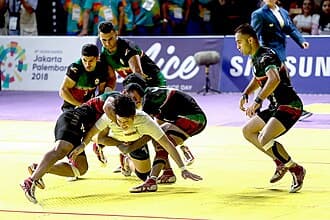
Kabaddi may well be the most widely played traditional team sport in the world, with hundreds of millions of players across South Asia. The game — in which a raider crosses into an opponent's half, tags players, and must return while holding their breath chanting "kabaddi kabaddi" — requires no equipment, no formal venue, and no financial investment. Its simplicity and intensity have made it a constant in the daily lives of rural and urban communities across India, Pakistan, Bangladesh, Nepal, and Sri Lanka for at least 4,000 years.
Sepak Takraw has a claim to continental ubiquity across Southeast Asia. Played in virtually every village and school across Thailand, Malaysia, Indonesia, Myanmar, Cambodia, and Vietnam, its circular form requires only a rattan ball and open space. Hundreds of millions of people have played it in some form, making it a serious rival to any European or American sport by participation volume.
Kho-Kho, another South Asian pursuit, rivals kabaddi in its simplicity and geographic spread, played across India and diaspora communities worldwide. Capoeira has spread from its Afro-Brazilian origins to over 160 countries. Glima (Iceland), laamb (Senegal), chidaoba (Georgia), and dozens more represent the highest expressions of their regional sporting cultures.
What Makes Traditional Games Endure?
The games that survive across centuries share common characteristics documented by ICTSG: minimal equipment requirements, deep embedding in seasonal or community rhythms, intergenerational transmission through play rather than formal coaching, and strong connection to local identity and values.
Unlike modern commercial sports — designed for spectator engagement and broadcast consumption — traditional sports were designed for the participants themselves. Their rules evolved through community consensus. Their venues were wherever communities gathered. Their seasons followed the agricultural or ceremonial calendar.
ICTSG's Role
The ICTSG Online Encyclopedia catalogues the world's traditional sports with the rigour of academic scholarship and the accessibility of community storytelling. Through its documentation work, ICTSG ensures that the full breadth of human sporting heritage — from kabaddi to ulama, from pato to kilikiti — is preserved for generations who will otherwise know only the narrow canon of modern commercialised sport.
The world's most popular traditional game may not be the most televised, the most funded, or the most recognised. But it is the one played this afternoon in a village square, a school yard, or a community centre by people who learned it from their grandparents — and who will pass it on to their grandchildren.
When a sport disappears, it is like a language no longer spoken - its stories, values, and lessons risk being lost forever. When we revive a game, we revive a culture.
Khalil Ahmed Khan - President, ICTSG