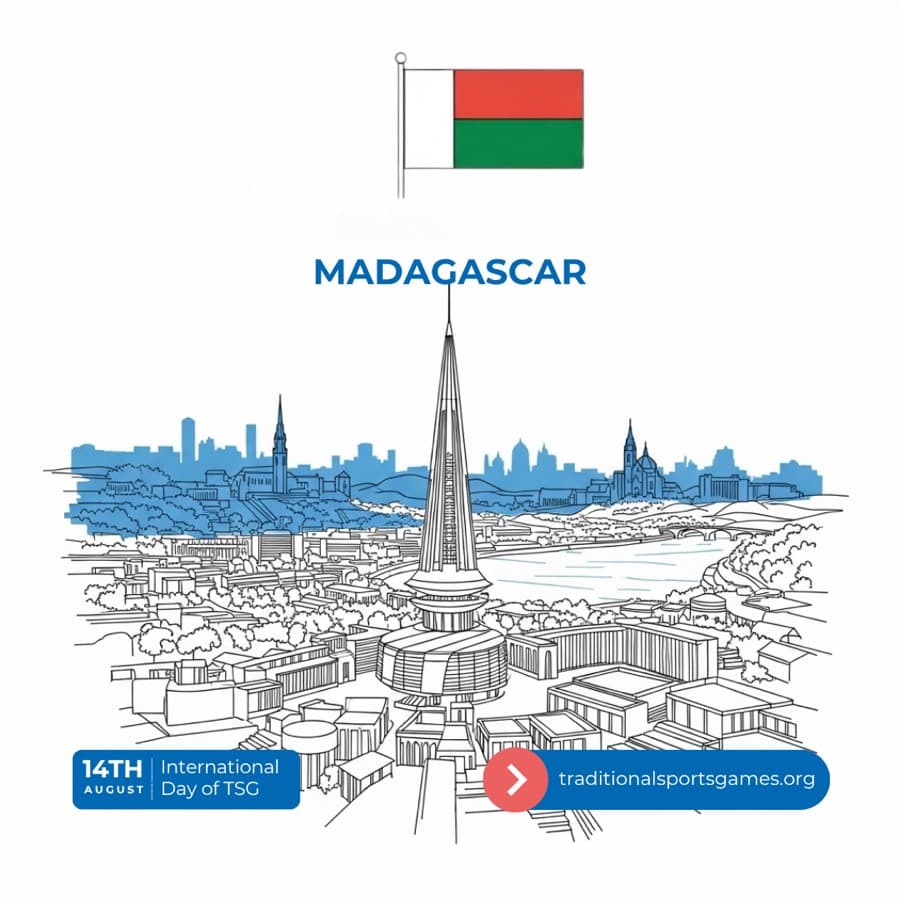
Positions Open with Madagascar Chapter 1. Chapter President for MadagascarApply Now 2. General Secretary for MadagascarApply Now 3. Information & Communications Lead for MadagascarApply Now Pre‑Qualification Checklist Benefits & Perks Responsibilities
Madagascar’s Cultural Contribution to ICTSG Formation Country Overview Madagascar, the world’s fourth-largest island, is located in the Indian Ocean off the southeastern coast of Africa. Known for its extraordinary biodiversity and rich indigenous cultures, Madagascar has a distinct identity rooted in its Austronesian and African heritage. The country’s traditional sports are an integral part of its national character, fostering unity and cultural pride. Madagascar at the 4th Collective Consultation on TSG On 13–14 August 2018, Madagascar officially participated in the 4th Collective Consultation Meeting on Traditional Sports and Games, held at Sheraton Grand Istanbul Atasehir, Turkey. Representing the country were:
H.E. Mrs. Harifera Elisa Rabernananjara- Ambassador - Permanent Delegation of Madagascar in UNESCO. Mr. Rocke Rajaofertra, Cultural Attaché - PD of Madagascar in UNESCO. Mrs. Marie Veronique Faratiana, Representative- PD of Madagascar in UNESCO
The delegation attended on behalf of the Permanent Delegation of Madagascar to UNESCO. The participation of these officials emphasized Madagascar’s commitment to cultural preservation through traditional games. The official documentation of this landmark gathering was signed by H.E. Mrs. Harifera Elisa Rabernananjara, acting in her capacity as national representative, strengthening Madagascar’s contribution to the founding of ICTSG. Geographic and Strategic Importance of Madagascar Positioned between Africa and Asia, Madagascar holds a unique position for cultural exchange and preservation. Its remoteness has preserved many ancient traditions, and its geography—ranging from coastal plains to tropical rainforests—supports a range of cultural practices and traditional games. Madagascar is a vital cultural bridge for both African and Austronesian sporting traditions. Traditional and Indigenous Sports of Madagascar
Moraingy: A traditional form of bare-knuckle martial art practiced mostly by young Malagasy men. It is both a rite of passage and a social gathering with music and celebration. Dating back to the 15th century, Moraingy remains a cornerstone of Malagasy physical culture. Savika: A form of traditional bull wrestling where contestants demonstrate courage and technique in subduing bulls during community festivals. Rooted in the Betsileo ethnic group, it is symbolic of bravery and endurance. Fantika: An indigenous wrestling sport popular among coastal tribes. Emphasizes agility and traditional values passed down generations.
Madagascar's Role in the Formation of ICTSG During the historic UNESCO meeting in Istanbul, Madagascar aligned with 40+ countries to co-establish ICTSG as a global platform dedicated to traditional sports. Their representation and signing of official documents laid the foundation for a future where traditional games are recognized, researched, and promoted globally. This act was a declaration of the country’s determination to ensure the legacy of indigenous sports continues for future generations. Weather and Climate Conditions Madagascar experiences diverse climate zones, influenced by elevation and proximity to the Indian Ocean. The eastern coast is humid and tropical, while the central plateau has a temperate climate, and the southwest is dry and semi-arid. This diversity has contributed to the evolution of region-specific sports like Savika in the highlands and Moraingy along coastal areas. Seasonal festivals often coincide with traditional sporting events that are climate-dependent. UN Sustainable Development Goals (SDG) Alignment Madagascar’s participation in ICTSG directly aligns with several United Nations Sustainable Development Goals:
Goal 4 – Quality Education: Traditional sports are embedded in informal education, preserving moral and cultural teachings. Goal 5 – Gender Equality: Some traditional games include female participants and foster inclusive practices. Goal 11 – Sustainable Cities and Communities: Safeguarding traditional games supports sustainable community life and cultural identity.
Historical Relevance and Future Contributions With centuries-old traditions like Moraingy and Savika still practiced widely, Madagascar’s role in preserving global heritage is unmatched. As a founding participant of ICTSG, the country is well-positioned to contribute research, host traditional sports festivals, and promote youth involvement. The government and civil society’s alignment with ICTSG initiatives ensures sustained development, documentation, and digital storytelling of traditional Malagasy games worldwide. Call to Action ICTSG invites the people of Madagascar and cultural preservationists to take an active role in continuing this mission. By participating in the ICTSG Madagascar Chapter, citizens can help revitalize traditions, encourage youth participation, and ensure indigenous sports are never forgotten. Get Involved Benefits of Joining Support ICTSG
About ICTSG: The International Council of Traditional Sports and Games (ICTSG) is dedicated to preserving, promoting, and revitalizing traditional sports and games as powerful tools for education, peace, and sustainable development.
About Us History
When a sport disappears, it is like a language no longer spoken - its stories, values, and lessons risk being lost forever. When we revive a game, we revive a culture.
Khalil Ahmed Khan - President, ICTSG