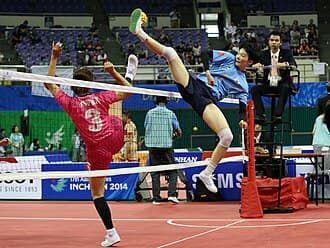
Sepak Takraw is one of the world's most visually spectacular traditional sports — a game in which players use every part of their body except their hands to strike a rattan ball over a net, executing bicycle kicks, scissor kicks, and acrobatic overhead strikes that have astonished audiences for centuries.
Origins and History
Sepak Takraw traces its origins to the Malacca Sultanate in the 15th century, where it was played in royal courts as a display of agility and martial arts skill. The name combines the Malay word "sepak" (kick) and the Thai word "takraw" (woven rattan ball). Over centuries it spread throughout Southeast Asia, becoming deeply embedded in the cultural traditions of Thailand, Malaysia, Indonesia, Philippines, Myanmar, Cambodia, Laos, and Vietnam.
Each country developed its own regional variants and competitive traditions, contributing to the rich tapestry of the sport's cultural heritage. The rattan ball itself — lightweight, hollow, and woven with extraordinary precision — is an artefact of traditional craftsmanship in its own right.
Sport Structure and Play
The standard competitive form is played between two teams of three players on a badminton-sized court divided by a net. The Tekong (server) strikes the ball from behind a service circle while the two other players — the Killer and the Feeder — position for attack and receive. Players may use feet, knees, chest, and head, but never hands.
The most celebrated element of sepak takraw is the roll spike — a bicycle-kick manoeuvre in which the attacker launches into the air, executing a full rotation to strike the ball downward at speed. Elite competitors achieve heights of over 1.5 metres while executing these techniques.
ICTSG and Global Recognition
The International Council of Traditional Sports and Games recognises Sepak Takraw as a flagship discipline in the global TSG movement. The sport has been featured at the Asian Games since 1990 and is played in over 70 countries, yet remains underrepresented in Western sports media and policy dialogues.
ICTSG works with the International Sepak Takraw Federation (ISTAF) and national bodies across Southeast Asia to document the sport's cultural heritage dimensions, advocating for UNESCO intangible heritage recognition that goes beyond competitive frameworks to acknowledge the game's social and community functions.
Cultural Dimensions
In many communities across Southeast Asia, sepak takraw is practised as a form of moving meditation, a male bonding ritual, and a vehicle for spiritual expression. Circular play — in which participants stand in a circle passing the ball using creative techniques — remains the game's most culturally embedded form, played in village squares, school yards, and temples from Bangkok to Bali.
ICTSG programmes support community circles of sepak takraw as vehicles for youth engagement, physical health, and the preservation of ancestral movement traditions that might otherwise be displaced by modern screen culture.
When a sport disappears, it is like a language no longer spoken - its stories, values, and lessons risk being lost forever. When we revive a game, we revive a culture.
Khalil Ahmed Khan - President, ICTSG