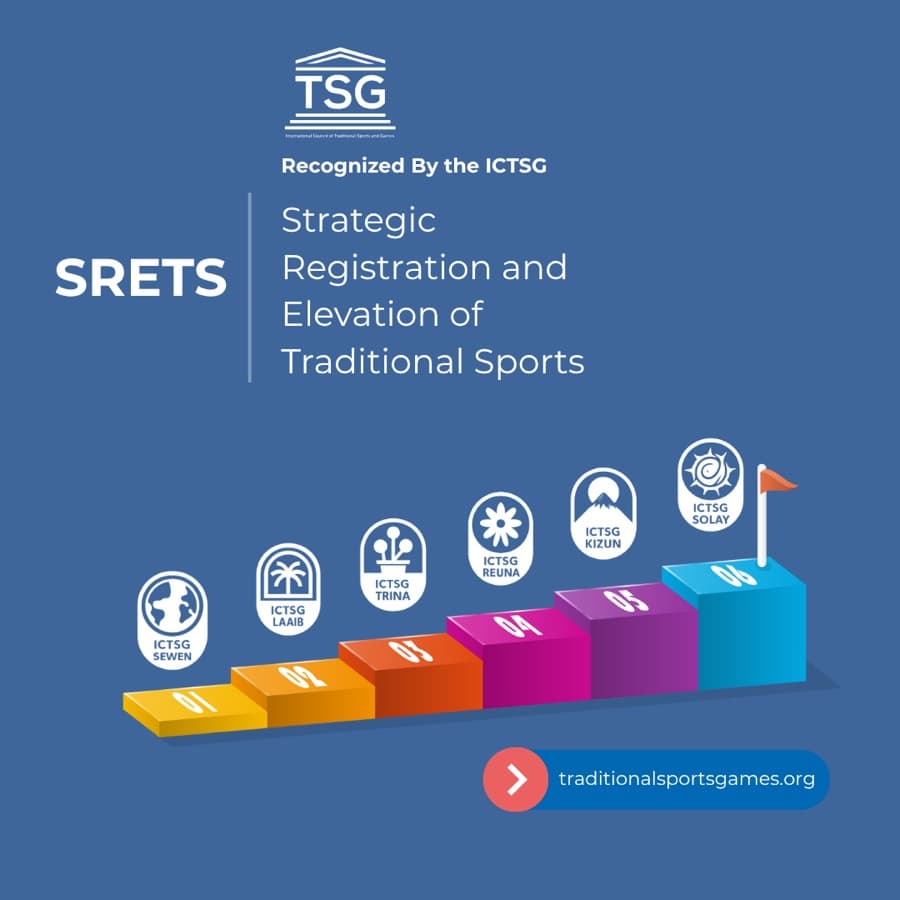
How to Register a Traditional Game with ICTSG – Step-by-Step Process The International Council of Traditional Sports and Games (ICTSG) serves as the global body for evaluating, elevating, and registering traditional games across communities, countries, and cultural institutions. If your game holds ancestral, ethnic, or community-based heritage, you may be eligible to register it officially within ICTSG’s six-stage Elevation Framework. Registering a game helps preserve cultural identity, secure recognition, enable educational use, and gain access to global development programs. 📝 Who Can Register a Traditional Game?
Cultural researchers or ethnographers Local elders or tradition bearers Ministries of culture, education, or youth Traditional sport federations or clubs Educational institutions preserving folk heritage
📋 Step-by-Step Guide to Registering Your Game Step 1: Identify the Nature of Your Game
Is it still practiced or nearly forgotten? Does it have community memory or documentation? Has it been included in festivals, curricula, or official events?
Based on this, you will choose one of the six stages below. Step 2: Match to a Stage in the ICTSG Framework
SEWEN – Safeguarding Endangered Wisdom of Ethnic Nations (oral stage) LAAIB – Local Ancestral Activities & Indigenous Base (archived traditions) TRINA – Tradition Recognized with Indigenous National Affirmation (national recognition) REUNA – Registered Entities with Unified National Affiliation (formal registration) KIZUN – Knowledge Integration for Zones of Unified Nations (intercultural visibility) SOLAY – Safeguarded Original Legacy as Acknowledged Yield (global heritage leadership)
Step 3: Prepare Your Submission Include the following:
Name of the game (in native and translated languages) Description and purpose Community, ritual, seasonal or symbolic meaning Game tools: Images or illustrations of materials used Rules: If available (oral or written) Photos and/or short video showing the game being played (if possible) Contact person or organization responsible for submission
Step 4: Submit Your Application Applications can be submitted through the ICTSG Contact Portal or during bi-monthly open calls for registration. Include all supporting materials digitally or via institutional endorsement (e.g., ministry letter, university recommendation). Step 5: Review by ICTSG Sports Review Commission Your application will be evaluated by a global panel of researchers, historians, and sports experts based on authenticity, cultural integrity, practice status, and documentation depth. Step 6: Receive Feedback and Stage Confirmation After review, ICTSG will recommend your game’s placement within the appropriate stage (SEWEN to SOLAY). You’ll also receive guidance for preservation, teaching, and global promotion where applicable. 🌐 Benefits of Registration
Institutional recognition and elevation under a global framework Support for inclusion in national curricula and cultural policies Visibility in global ICTSG reports, portals, and exhibitions Eligibility for research grants, heritage awards, and festival invitations Alignment with UN Sustainable Development Goals (SDGs)
🎯 SDGs Supported Through Registration
SDG 4: Education through traditional knowledge SDG 5: Gender equality in heritage games SDG 10: Reduced cultural inequality SDG 11: Sustainable cultural cities and communities SDG 16: Peace-building through shared traditions SDG 17: Partnerships for preservation and innovation
❓ Frequently Asked Questions How long does the registration process take? Typically 4–8 weeks depending on documentation completeness and the stage of submission. Can individuals submit games or must it be an organization? Both are welcome. However, community-based or institution-supported submissions are preferred for verification and sustainability. Is there a cost to register a traditional game? No. ICTSG does not charge for evaluation or registration. However, digital preparation and translation support are the responsibility of the applicant. Can I submit more than one traditional game? Yes, as long as each game has a distinct cultural identity and documentation, multiple games can be submitted. Will my game be featured globally? Games at the REUNA, KIZUN, or SOLAY stages are eligible for international showcasing, festival partnerships, and academic exhibitions.
Get Involved Benefits of Joining Support ICTSG
About ICTSG: The International Council of Traditional Sports and Games (ICTSG) is dedicated to preserving, promoting, and revitalizing traditional sports and games as powerful tools for education, peace, and sustainable development.
About Us History Contact
When a sport disappears, it is like a language no longer spoken - its stories, values, and lessons risk being lost forever. When we revive a game, we revive a culture.
Khalil Ahmed Khan - President, ICTSG